Why Customer Feedback Matters
Businesses today have more operational data than ever. Sales, order volumes, footfall, conversion rates and product usage can give you a clear picture of what is happening. But numbers alone often fail to answer an equally important question: why is it happening?
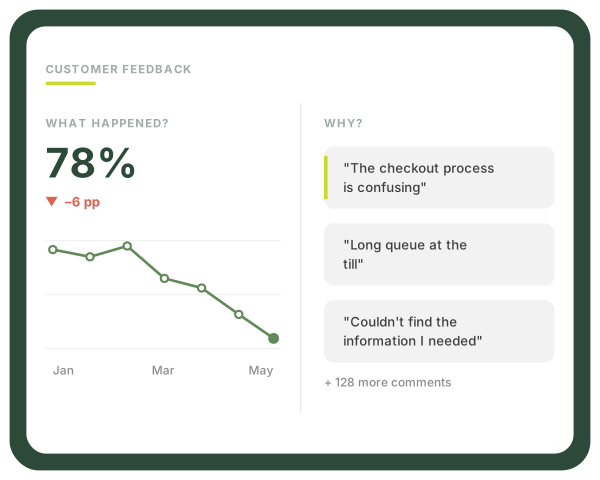
Why did a customer decide not to come back? Why does one location consistently outperform another? Why did satisfaction fall after a new process was introduced? Which part of the service creates the most friction?
Customer feedback helps fill that gap. Its value goes far beyond calculating a satisfaction score or adding another KPI to a report. When collected systematically, feedback helps organisations understand what customers are actually experiencing, identify recurring issues and make decisions based not only on internal assumptions, but on the voice of the customer.
| Question | Short answer |
|---|---|
| What does customer feedback help you understand? | Not just what happened, but why customers experienced or rated it the way they did. |
| When is feedback most valuable? | When it is collected at a relevant point in the customer journey and with a clear objective. |
| When does it create business value? | When insights are used to identify trends, inform decisions and drive meaningful change. |
On this page:
- Numbers tell you what happened. Customers can tell you why.
- Less guesswork, more evidence for better decisions
- Negative feedback? Sometimes it is the most valuable signal
- Customer satisfaction is more than just a score
- The goal is not to survey everyone — it is to know what you want to learn
- Collecting responses is only the first step. Understanding them is what matters.
- Sources
Numbers tell you what happened. Customers can tell you why.
When you work inside an organisation, it is easy to become accustomed to the way things are done. A registration form feels intuitive because employees have seen it hundreds of times. A self-service portal seems straightforward because the team already knows how to use it. A new service makes perfect sense to the people who designed it because they know the reasoning behind every decision.
Customers do not have that context. They are simply trying to sign up, place an order, use a service or solve a problem. That outside perspective can reveal friction points that have become almost invisible to people inside the organisation.
Research into customer feedback suggests that it can help organisations identify problem areas, understand their strengths and uncover new opportunities for service improvement. Source
“Customer feedback can help identify both problem areas and strengths, while also generating ideas for service improvement.”
Adapted from Wirtz, Tambyah and Mattila, Journal of Service Management, 2010.
In practice, the issue might be a long wait, a confusing checkout process, missing information or a particular step in the customer journey that repeatedly causes frustration. But feedback is not only useful for finding problems. It can also reveal what you are doing particularly well and what customers value most.
For example, customers at one location may consistently rate the service more highly than at another. Or one part of the experience may repeatedly appear in comments as a major strength. That gives you the opportunity not only to fix what is not working, but also to understand and replicate what already works well.
Customer feedback helps close the gap between how an organisation believes it performs and how customers actually experience it.
One comment alone is rarely enough to justify changing an entire process. But when the same issue appears repeatedly across responses from different customers, it becomes a much stronger signal. Systematic feedback collection helps you move from isolated opinions to meaningful patterns.
Less guesswork, more evidence for better decisions
Whether they collect customer feedback or not, organisations still make decisions about their products, services and processes. The difference is that without customer input, those decisions leave much more room for assumptions. A new feature seems to be well received. A recurring issue appears to be relatively unimportant. Everything looks fine because hardly anyone is complaining.
But silence does not necessarily mean satisfaction. An unhappy customer is under no obligation to tell you why they are leaving. They may simply choose another restaurant, gym, retailer or service provider.
By proactively asking for feedback, organisations can also hear from customers who would probably never contact them on their own. Feedback is particularly valuable when it is collected at a specific moment in the customer journey — for example, after a purchase, a service interaction, a visit or the first use of a new feature. This gives you insight into a specific experience rather than a vague overall opinion of the company.
Research suggests that actively collecting customer feedback can lead organisations to make more changes in the areas customers themselves highlight. In one study examining systematic feedback collection, these customer-informed changes were also associated with stronger revenue and profit outcomes. Source
That does not mean sending a survey automatically increases revenue. The value comes from what happens next: customer responses reveal information that can be used to make better decisions.
How can customer feedback create business value?
Collect feedback → better understand customer needs and pain points → make more informed decisions → improve the customer experience → potentially increase loyalty and improve business performance
This is not a formula that guarantees higher revenue every time you run a survey. However, research supports different links in this chain. Feedback can help organisations identify issues and make changes that matter to customers, while stronger customer experience and satisfaction have been associated with retention, referrals, customer spending and financial performance. Source
Negative feedback? Sometimes it is the most valuable signal
Positive feedback confirms that something is working. Negative feedback can sometimes tell you even more. If customers repeatedly fail at the same step in a process, they are pointing directly to a source of friction. If customers consistently mention excessive waiting times at one location, that may indicate a broader operational issue rather than a one-off bad experience.
Research on customer complaints suggests that their value extends beyond resolving an individual customer's problem. Organisations can use complaint data to improve processes and services, and learning from complaints has been linked to both stronger short-term and long-term business performance. Source
Negative feedback should therefore not be treated purely as something to resolve and move on from. It can also serve as an early warning signal for a problem that needs to be addressed at a broader level.
One complaint may be an individual customer's problem. A recurring complaint may be an organisational problem.
Customer satisfaction is more than just a score
One of the most common reasons organisations collect customer feedback is to measure satisfaction. Yet customer satisfaction is sometimes treated as a relatively “soft” metric — useful for customer service or customer experience teams, but less relevant to wider business performance.
Decades of research suggest otherwise. Customer satisfaction has been associated with customer retention, recommendations, spending behaviour and a range of financial performance measures. Source
Earlier research has also found a relationship between customer satisfaction and stronger economic performance at the company level. This does not mean that a high satisfaction score automatically guarantees growth. It does, however, suggest that customer experience and business performance are not entirely separate issues. Source
If customer experience influences whether people return, how much they spend and whether they recommend your business to others, understanding that experience becomes a business priority — not just a CX metric.
At the same time, an overall score is rarely enough. If customer satisfaction has been declining for several months, the score tells you that something has changed. It does not tell you why. To take meaningful action, you need context. Follow-up questions and open-ended customer comments can provide the explanation that a single number cannot.
The goal is not to survey everyone — it is to know what you want to learn
A good feedback programme does not mean asking customers to complete a survey after every possible interaction. What matters far more is knowing what you want to learn. In one case, the priority may be tracking overall customer satisfaction over time. In another, it may make sense to ask about a specific experience immediately after a service interaction. In another, you may need to understand why a customer cancelled or how customers responded to a recently launched feature.
Effective feedback collection therefore depends not only on asking the right questions, but also on choosing the right moment, channel and metric. The same approach will not necessarily work equally well for every organisation or every customer journey.
How do you choose the right customer feedback metric?
There is no single best metric. The right choice starts with a simpler question: what exactly do you want to understand about your customers?
Collecting responses is only the first step. Understanding them is what matters.
Customer feedback can uncover issues that would otherwise go unnoticed, highlight strengths, provide better evidence for decision-making and explain what sits behind headline satisfaction metrics. But its real value emerges when customer feedback does not simply sit in a dashboard or report — it becomes an input for action.
That raises another important question: what happens once you have hundreds or thousands of responses? How do you identify the themes that keep appearing? How do customer experiences differ across locations, segments or other groups? Which issues deserve attention first?
Apklausa360 brings these steps together in one platform. You can collect customer feedback, analyse quantitative results, compare responses across customer groups or other variables, and use AI-powered analysis to process larger volumes of open-ended feedback and identify recurring themes and sentiment.
The goal is not to collect as many responses as possible. It is to understand what customers are telling you.
Collecting feedback is not enough. How do you turn responses into insights?
1,000 responses do not automatically give you 1,000 insights. The value comes from understanding what keeps appearing in the data, why it matters and what you should do next.
Sources
The conclusions discussed in this article are supported by the academic research listed below. Links lead to the original publication pages.
| Source | Link |
|---|---|
| Kaul, R., Anderson, S. J., Chintagunta, P. K. and Vilcassim, N. Call Me Maybe: Does Customer Feedback Seeking Impact Nonsolicited Customers? Marketing Science. | View the study |
| Wirtz, J., Tambyah, S. K. and Mattila, A. S. (2010). Organizational learning from customer feedback received by service employees: A social capital perspective. Journal of Service Management. | View publication details |
| Yilmaz, C., Varnali, K. and Kasnakoglu, B. T. (2016). How do firms benefit from customer complaints? Journal of Business Research. | View the study |
| Mittal, V. et al. (2023). Customer satisfaction, loyalty behaviors, and firm financial performance: what 40 years of research tells us. Marketing Letters. | View the research review |
| Anderson, E. W., Fornell, C. and Lehmann, D. R. (1994). Customer Satisfaction, Market Share, and Profitability: Findings from Sweden. Journal of Marketing. | View the study |
NPS, CSAT or CES: which customer feedback metric should you use?
There is no single best metric. Learn how NPS, CSAT and CES differ, when each one is most useful and why their value can vary across industries.
Collecting feedback is not enough: how do you turn customer responses into insights?
Learn how to move from individual responses to recurring themes, root causes and priorities — and why a single average can hide several very different customer experiences.