Mental Health at Work: How to Take the Organisation’s “Temperature”
World Mental Health Day is observed on 10 October. For organisations, it is an opportunity not only to highlight the importance of mental wellbeing, but also to ask a more practical question: how much do we really know about employees’ day-to-day experience at work?
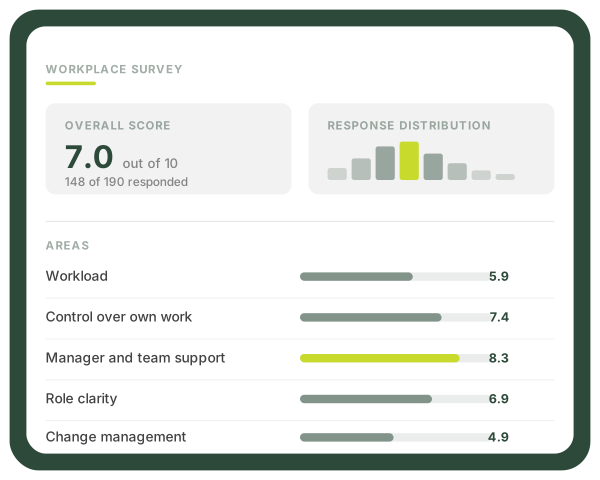
Completed tasks and performance metrics do not tell you whether employees have enough time to do their work, whether priorities are clear, whether they receive support when they need it, or whether organisational changes make sense to them. To understand that, organisations need to look not only at outcomes, but also at the conditions under which those outcomes are achieved. Source
An employee survey can be one way to understand those conditions. But taking the organisation’s “temperature” should not mean attempting to diagnose employees. The UK Health and Safety Executive (HSE) recommends using surveys as one source of information and emphasises that they should be treated as an initial indicator of the situation, not as a diagnosis of every possible cause of work-related stress. Source
On this page:
- World Mental Health Day 2026: what does this year’s theme mean?
- Why look at working conditions, not only individual wellbeing?
- What should an employee survey measure?
- One average does not tell the whole story
- Open-ended responses help explain why
- How often should you take the organisation’s “temperature”?
- Anonymity should be more than a promise
- The most important part starts after the survey
- From collected responses to clearer decisions
- Sources
World Mental Health Day 2026: what does this year’s theme mean?
The World Health Organization’s 2026 campaign theme is “Lived experiences heard: real voices, real change.” The campaign focuses on the meaningful involvement of people with lived experience of mental health conditions in decisions that affect their lives. Source
It is important not to stretch that context too far. The WHO campaign is not specifically about employee surveys. However, its central idea raises a relevant question for organisations: are people’s experiences merely being collected, or are they actually informing decisions? The WHO emphasises that meaningful involvement needs to go beyond simply giving people an opportunity to be heard.
Working days lost each year
According to the WHO, depression and anxiety lead to an estimated 12 billion working days being lost globally each year, at a cost of around US$1 trillion in lost productivity. Source
Why look at working conditions, not only individual wellbeing?
The WHO identifies a range of psychosocial risks at work, including excessive workloads, low job control, unclear roles, limited support from colleagues or managers, harassment, discrimination, job insecurity and other adverse working conditions. Well-designed work, on the other hand, can provide a sense of purpose, confidence and social connection. Source
Research supports this connection. A systematic review and meta-analysis by Madsen and colleagues examined job strain — the combination of high job demands and low control. Across published studies, job strain was associated with a 1.77 times higher risk of clinical depression. In additional individual-participant data, the association was smaller but still statistically significant, with a relative risk of 1.27. Because most of the evidence is observational, these findings do not mean that a specific person’s depression was caused by their job. Source
The practical implication for organisations is straightforward: employee wellbeing should not be reduced to an individual’s ability to cope with stress. It is also worth examining the working conditions the organisation itself can influence — workload, clarity of priorities, support, roles, relationships and change management. Source
Wellbeing at work is not only an individual characteristic. It is also shaped by how work is organised.
What should an employee survey measure?
A broad question such as “How do you feel at work?” can be a useful conversation starter, but it is usually not specific enough to support decisions. The HSE Management Standards framework identifies six areas of work design related to work-related stress: demands, control, support, relationships, role and change. Source
| Area | Example survey statement |
|---|---|
| Workload | I can complete my core responsibilities within my agreed working hours. |
| Control over work | I have a say in how I organise my work. |
| Manager and team support | I can get help from my manager or colleagues when I need it. |
| Relationships | People in my team treat one another with respect. |
| Role clarity | I clearly understand what is expected of me at work. |
| Change management | I receive enough information about changes that affect my work. |
Important: these questions are illustrative. They are not a validated psychological assessment and are not an official translation of the HSE questionnaire. If an organisation needs a standardised assessment of the psychosocial work environment, it is better to use a validated methodology designed for that purpose.
One example is the Copenhagen Psychosocial Questionnaire, COPSOQ III. The publication describing the third version analysed data from 23,361 employees across six countries, with most of the assessed scales showing adequate reliability. However, the psychometric properties of a validated methodology cannot automatically be assumed to apply to a questionnaire that has been independently translated, shortened or otherwise modified. Source
When creating a short internal survey, it is also useful to follow established survey design principles: measure one thing per question, use clear language, avoid leading wording, and provide appropriate options such as “not applicable” or “prefer not to answer” where relevant. Source
One average does not tell the whole story
Imagine a hypothetical employee survey in which the overall workplace experience score is 7 out of 10. The same average could result from almost everyone selecting 7 — or from one group of employees rating the experience very highly while another rates it much lower. The average is identical, but the reality inside the organisation may be completely different.
That is why it is useful to look beyond the headline average and examine the distribution of responses, changes over time and differences between groups, where those comparisons can be made safely and meaningfully. It is also important to understand who responded. If only a small or highly specific group of employees took part, the results may not reflect the experience of the wider organisation. Source
The average shows the direction. The distribution shows who may be struggling most.
Open-ended responses help explain why
A number can show that something is changing, but it cannot always explain the reason. For example, a lower workload score in one team may be accompanied by comments about having too many tasks, while another team may describe constantly shifting priorities. The headline issue may look similar, but the appropriate response would be different.
That is why rating scales can be supplemented with a small number of open-ended questions, for example:
What currently helps you most to feel and work well?
and:
What one change would make your work easier?
Open-ended questions allow employees to respond in their own words. However, if those responses are going to be summarised quantitatively, they require consistent coding and interpretation. Source
If AI is used to group or summarise comments, automated outputs should be treated as an analytical aid rather than a clinical assessment. Before making important decisions, organisations should review the original context and check that automated summaries have not removed or distorted important meaning.
How often should you take the organisation’s “temperature”?
There is no universal rule saying employee surveys should be run monthly, quarterly or once a year. The HSE recommends linking follow-up measurement to the actions being implemented and to the amount of time in which it would be reasonable to expect those actions to have an effect. Source
In practice, a broader annual or periodic workplace survey can be complemented by shorter pulse surveys focused on specific topics. For example, after changing the work-planning process, the organisation could reassess clarity of priorities and workload after an agreed period. When comparing results over time, it is helpful to keep the core questions and scales consistent, because changing the wording can also change how people respond. Source
A better question than “How often should we send a survey?” is: “When will we be ready to make meaningful use of the next set of responses?”
Anonymity should be more than a promise
Before launching the survey, employees should be told clearly why responses are being collected, who will be able to access them, how results will be reported and how long the data will be retained. It is particularly important to distinguish accurately between an anonymous survey and a confidential one. Not asking for a name does not automatically make a survey anonymous. A person may still be identifiable from their job title, department, demographic characteristics or a specific situation described in an open-ended comment. Source
The EDPB’s 2026 Guidelines on Anonymisation are currently published as a Version 1 document for public consultation. They should therefore be treated as an indication of the regulator’s current direction rather than as the final version of the guidance. Source
A general workplace survey also does not automatically need to collect information about diagnoses, treatment or medication. Under the GDPR, health data linked to an identifiable person falls within special categories of personal data and is subject to additional protection. If a survey collects sensitive health information, its purpose and legal basis for processing should be assessed separately. Source
The most important part starts after the survey
Research on employee surveys does not focus only on questionnaire design. What happens after the responses have been collected matters as well. A systematic review by Huebner and Zacher found that survey follow-up — including discussing results, planning actions and implementing them — is an important part of the overall employee survey process. The authors also note that the empirical evidence in this area remains limited and that existing findings are not entirely consistent. Source
The HSE likewise recommends going beyond collecting results. Organisations should monitor whether agreed actions are actually implemented, assess whether they are effective and decide whether further measures or additional data are needed. Source
For example:
“Unclear priorities came up repeatedly in the responses. Starting next month, teams will agree on the week’s top priorities at the beginning of each week. If new urgent work appears, the team will also decide what can be deprioritised. We will revisit this question in two months to see whether priorities have become clearer.”
Not every suggestion can be implemented. But employees can still be told clearly what will be addressed now, what requires more time and what the organisation is not currently able to change. That turns the survey from a data-collection exercise into part of a consistent listening and decision-making process.
From questionnaire to results in one place
Apklausa360 can help you collect and analyse employee feedback in one place. Let’s discuss what that could look like in your organisation.
From collected responses to clearer decisions
World Mental Health Day can be a useful opportunity to start a more structured conversation about the work environment. But the value of taking the organisation’s “temperature” should not depend on a single date in the calendar. The most important outcome is not the survey score itself. The value comes from understanding more clearly what is working, where employees are experiencing difficulties and what may need to change.
Apklausa360 allows organisations to collect feedback, analyse results across different segments and use AI to identify sentiment and recurring themes in open-ended responses. These capabilities can help structure larger volumes of feedback, but decisions about working conditions, employee support and organisational change remain with the organisation itself.
A survey collects responses. Change comes from what the organisation decides to do with them.
Sources
| Source | How it is used in this article | Link |
|---|---|---|
| World Health Organization (2026). World Mental Health Day 2026: Lived experiences heard: real voices, real change. | 2026 campaign theme and the principle of meaningful involvement in decision-making. | Open page |
| World Health Organization (2024). Mental health at work. Fact sheet. | Psychosocial risks at work and estimates of lost working days and productivity. | Open page |
| Health and Safety Executive, HSE. Surveys: Management Standards approach. | Surveys as an initial indicator rather than a diagnosis of the causes of work-related stress. | Open page |
| Health and Safety Executive, HSE. What are the Management Standards? | The six work design areas used as the basis for the illustrative survey statements in this article. | Open page |
| Health and Safety Executive, HSE. Step 5: Monitor and review. | Timing of follow-up measurement and monitoring agreed actions after a survey. | Open page |
| Madsen, I. E. H., et al. (2017). Job strain as a risk factor for clinical depression: systematic review and meta-analysis with additional individual participant data. Psychological Medicine, 47(8), 1342–1356. | The association between high job demands combined with low control and risk of clinical depression. | View study |
| Burr, H., et al. (2019). The Third Version of the Copenhagen Psychosocial Questionnaire. Safety and Health at Work, 10(4), 482–503. | Example of a validated psychosocial work environment methodology and its scope. | View study |
| Huebner, L. A. & Zacher, H. (2021). Following Up on Employee Surveys: A Conceptual Framework and Systematic Review. Frontiers in Psychology, 12, 801073. | Why discussion of results, action planning and implementation are part of the employee survey process. | View study |
| American Association for Public Opinion Research, AAPOR (2022). Best Practices for Survey Research. | Question design principles, the importance of respondent composition and communicating anonymity. | Open page |
| European Data Protection Board, EDPB (2026). Guidelines 02/2026 on Anonymisation, Version 1 (public consultation). | Current regulatory direction on anonymisation; not yet a final version of the guidelines. | Open page |
| European Commission. Special categories of personal data under the GDPR. | Why health data linked to an identifiable person requires additional legal consideration. | Open page |
Collecting Feedback Is Not Enough: How to Turn Feedback Into Insights
Why averages can be misleading, what open-ended comments add and how insights can reach the people who are able to act on them.
Why Collect Feedback?
What feedback can reveal that numbers alone cannot, and how it can translate into decisions and practical value.
Customer Experience Management From End to End
How feedback collection, analysis and action can be brought together into one continuous process.