CSAT: What It Is and How to Calculate Customer Satisfaction Score
CSAT, or Customer Satisfaction Score, is a customer satisfaction metric that shows what proportion of customers are satisfied with a specific service, purchase, consultation or other experience. It is usually measured immediately after a specific customer interaction or event and expressed as a percentage.
CSAT = number of positive responses ÷ total number of responses × 100%
On a 1–5 scale, ratings of 4 and 5 are most commonly treated as positive responses.
| Question | Short answer |
|---|---|
| What does CSAT stand for? | Customer Satisfaction Score |
| What does it measure? | Satisfaction with a specific experience |
| How is it calculated? | The percentage of positive responses |
| When is it measured? | Immediately after a purchase, service interaction or other event |
| Most common scale | 1–5 |
| How is it different from NPS? | CSAT measures satisfaction with an experience; NPS measures loyalty and likelihood to recommend |
On this page:
- What is CSAT?
- How is CSAT calculated?
- What is a good CSAT score?
- What CSAT question should you ask?
- Which CSAT scale should you use?
- When should you run a CSAT survey?
- How should you analyse CSAT results?
- How is CSAT different from NPS and CES?
- How does Apklausa360 help measure CSAT?
- Frequently asked questions
What is CSAT?
CSAT is one of the most widely used customer experience metrics in the world. Its popularity comes largely from its simplicity: customers are asked one clear question about a specific experience, and the result is calculated using a straightforward formula that is easy for both managers and frontline teams to understand.
What does Customer Satisfaction Score mean?
The name describes exactly what the metric measures:
- Customer Satisfaction – how satisfied customers are;
- Score – the calculated metric;
- CSAT is usually expressed as a percentage showing how many respondents were satisfied.
CSAT is therefore a direct measure of the proportion of customers who rated a specific experience positively.
What exactly does CSAT measure?
CSAT measures satisfaction with a clearly defined customer experience, such as:
- a specific purchase;
- a service interaction;
- a consultation;
- issue resolution;
- a product or service;
- a specific stage in the customer journey.
It is important to understand that CSAT is generally not a measure of overall customer loyalty. It is designed to evaluate a specific interaction or clearly defined period, which is why it works best when customers are asked about something that has just happened rather than their overall perception of the organisation.
NPS is more commonly used to assess the broader customer relationship and loyalty. You can read more about the distinction in the comparison section.
How is CSAT calculated?
CSAT formula
CSAT is calculated using the following formula:
CSAT = number of satisfied customer responses ÷ total number of responses × 100%
One important distinction: CSAT is not the arithmetic mean of all ratings. It is the percentage of responses classified as positive. These are related, but different metrics:
- average rating: 4.2 out of 5;
- CSAT score: 82%.
An average gives you the overall level of responses, but can hide the underlying distribution. The same average of 4.2 could come from a group of consistently satisfied customers or from a mix of extremely satisfied and highly dissatisfied customers.
CSAT answers a more specific question: what proportion of customers rated the experience positively?
Which ratings count as positive?
| Scale | Ratings commonly treated as positive |
|---|---|
| 1–5 | 4 and 5 |
| 1–7 | 6 and 7 |
| 1–10 | A predefined top range, such as 8–10 or 9–10 |
The organisation defines which ratings count as positive. What matters most is that the same calculation rule is used consistently throughout the measurement period.
If you change the threshold halfway through the year, the results are no longer directly comparable. Any apparent change in CSAT may reflect the calculation method rather than a genuine change in customer experience.
CSAT calculation example
Suppose 100 customers complete a post-service survey using a 1–5 scale:
| Rating | Number of responses |
|---|---|
| 5 – Very satisfied | 58 |
| 4 | 24 |
| 3 | 10 |
| 2 | 5 |
| 1 – Very dissatisfied | 3 |
The calculation is:
- positive responses: 58 + 24 = 82;
- total responses: 100;
- CSAT = 82 ÷ 100 × 100%;
- final CSAT score = 82%.
In other words, just over eight in ten customers rated the experience positively.
Customers who selected 3, as well as those who gave low ratings, are not counted as satisfied in the CSAT calculation. However, their responses remain highly important for analysis because they often show where the experience needs to improve.
What is a good CSAT score?
Why is there no universal “good” CSAT score?
There is no single threshold at which CSAT automatically becomes “good”. Results depend on factors that vary significantly between organisations, including:
- industry – customer expectations and rating behaviour differ across sectors;
- type of service – a routine interaction and the resolution of a complex problem are evaluated differently;
- survey timing – responses collected immediately after an event may differ from those collected a week later;
- scale and positive-response threshold – the methodology affects the result;
- customer segment – new and long-standing customers may rate the same experience differently;
- customer journey stage – delivery, consultation and issue resolution may naturally have different baseline satisfaction levels.
For this reason, mechanically comparing your CSAT with results from other countries or sectors is often more misleading than useful.
What should you compare your CSAT against?
Internal comparisons are usually far more useful:
- current performance versus previous periods;
- one branch versus another;
- one service channel versus another;
- one service versus another;
- different stages of the customer journey;
- performance before and after a process change.
A good CSAT score is not simply a high percentage. It is also a result that is stable, improving or under control — and one that the organisation can connect to specific actions. If CSAT improves after changes are introduced and declines when a process starts underperforming, the measurement is doing its job: it is helping the organisation make better decisions.
What CSAT question should you ask?
Standard CSAT question
A typical CSAT question is:
How satisfied are you with [the service, support interaction or experience]?
Response scale:
- 1 – Very dissatisfied;
- 5 – Very satisfied.
It is best to ask about a specific experience rather than something abstract such as “Are you satisfied with our company?” The more clearly you define the experience in the question, the more precisely you will understand what the customer is rating — and the easier it becomes to connect the result with a specific process or team.
| Situation | Example CSAT question |
|---|---|
| After a purchase | How satisfied are you with your shopping experience? |
| After a consultation | How satisfied are you with the consultation you received? |
| After a customer service interaction | How satisfied are you with the support provided by our team? |
| After issue resolution | How satisfied are you with how your issue was resolved? |
| After receiving a service | How satisfied are you with the quality of the service provided? |
| After delivery | How satisfied are you with the delivery experience? |
| After a digital process | How satisfied are you with the registration or ordering process? |
When should you add an open-ended question?
A numeric rating tells you how the customer evaluated the experience, but not why. That is why it is useful to follow the main CSAT question with an open-ended question such as:
What was the main reason for your rating?
The follow-up can also be tailored to the score. For customers who give a low rating:
What could we have done better?
For customers who give a high rating:
What did you like most?
For a transactional CSAT survey, these two questions are often enough: one rating question and one open-ended comment. Longer surveys tend to reduce response rates, while these two questions already capture both the score and the context behind it.
Which CSAT scale should you use: 1–5, 1–7 or 1–10?
| Scale | Advantages | Disadvantages | Best suited for |
|---|---|---|---|
| 1–5 | Simple, quick and easy to interpret | Less granular | Most transactional CSAT surveys |
| 1–7 | More detailed response options | Harder for respondents to distinguish between similar points | More detailed research |
| 1–10 | Familiar to many customers | Can be confused with NPS; positive ratings must be clearly defined | Organisations already using 10-point rating scales |
The choice of scale does not change the customer experience itself, but it affects how easy the survey is for customers to answer and how easy the results are for the organisation to interpret.
For most standard CSAT questions, a 1–5 scale is often the most practical because it is:
- easy to understand without additional explanation;
- quick to complete, especially on mobile or POS screens;
- clear in separating dissatisfied, neutral and satisfied customers;
- easy to communicate across the organisation.
The most important rule is consistency. Once you choose a scale, keep using it. Results collected on different scales should not be compared directly, so changing the scale breaks the continuity of your historical data.
When should you run a CSAT survey?
CSAT after a specific customer interaction
CSAT works best as a transactional metric — measured after a specific event while the experience is still fresh. Common measurement points include:
- after a purchase;
- after product delivery;
- after a branch visit;
- after a consultation;
- after a phone support interaction;
- after a customer service case;
- after issue resolution;
- after training or an event;
- after registration or another digital process.
You do not need to measure CSAT everywhere at once. A practical approach is to start with one or two of the most important customer journey touchpoints — where interaction volumes are highest or where you suspect the biggest problems — and expand the programme gradually.
How soon after the event should you send the survey?
The core principle is simple:
Ask the CSAT question while the customer can still clearly remember the experience being evaluated.
The more time passes, the more the response starts to reflect the customer's general perception of the organisation rather than the specific experience you are trying to measure.
The survey can be delivered through different channels:
- immediately on the website;
- on a POS terminal;
- on a tablet at the service location;
- by email after the interaction;
- by SMS or another automated message;
- via QR code.
The channel should match the touchpoint. At a physical service location, a tablet or QR code may be natural. After delivery, email may work better. In a digital journey, an in-product or on-site survey may be more appropriate.
How can you avoid sending surveys too late?
A common operational problem is sending surveys manually. For example, a customer list may be exported weekly or monthly and survey invitations then sent in batches. This creates two issues.
First, some customers may receive the survey several weeks after the interaction, when the experience is no longer fresh. That can distort the result.
Second, manual processes are fragile. If the person responsible is unavailable, measurement may simply stop.
A more reliable approach is to connect the survey to a specific system event:
- order delivered;
- consultation completed;
- support case marked as resolved;
- customer visited a branch;
- service delivered.
The survey can then be triggered automatically and consistently at the same point in the journey. That improves comparability and removes dependence on manual work.
Measure CSAT at the right moment
Apklausa360 can automatically trigger a survey after a purchase, consultation, issue resolution or another event of your choice — so customers receive the survey while the experience is still fresh.
How should you analyse CSAT results?
Overall CSAT is not enough
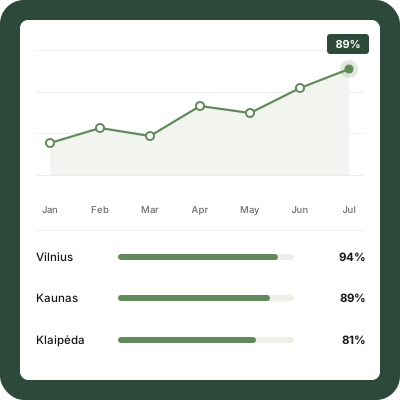
A single overall percentage can hide significant differences. For example:
- overall CSAT: 86%;
- one branch: 94%;
- another branch: 68%.
Looking only at the headline score, the organisation appears to be performing well. Meanwhile, the 68% branch could underperform for months without receiving enough attention.
The real value of CSAT analysis appears when the headline metric is broken down into segments that reflect how the organisation actually operates.
How should you segment CSAT results?
Results should be analysed using the dimensions that the organisation actually uses to make decisions, such as:
- business unit;
- city or region;
- service;
- product;
- service channel;
- customer segment;
- employee or team;
- customer journey stage;
- date or time period;
- survey channel.
For this type of analysis to work, every response needs context. You need to know where the interaction happened, what event triggered the survey and which customer segment the respondent belongs to. If feedback is collected without this context, you are left with little more than the overall percentage.
How should you compare different customer journey touchpoints?
If CSAT is measured at several stages of the journey, those results can be compared directly. For example:
- purchase process;
- delivery;
- consultation;
- issue resolution;
- after-sales service.
This helps identify where satisfaction drops. If the purchase experience has a CSAT of 90% but delivery scores 72%, you know where to focus attention first.
Without this breakdown, organisations often improve the process that is most visible internally rather than the one that creates the most friction for customers.
How should you analyse open-ended customer comments?
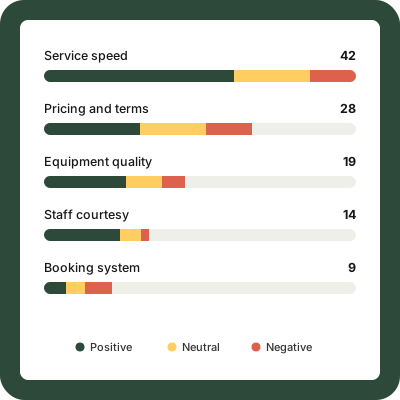
Numeric ratings show the level of satisfaction. Open-ended comments explain the reasons behind it. To turn comments into insights rather than an unread list of text, they should be analysed systematically:
- Connect each comment with its CSAT rating.
- Group comments into themes.
- Separate positive and negative sentiment.
- Identify recurring problems.
- Analyse themes by business unit, service and time period.
- Track whether implemented changes reduce the volume of negative comments.
How should you work with low scores?
A low CSAT rating is not just a data point. It is also a signal from a specific dissatisfied customer. Organisations that use CSAT operationally often turn low ratings into a closed-loop feedback process:
Low rating
The customer gives the experience a low score. The system captures it immediately rather than waiting for a monthly report.
Identify the cause
The open-ended comment and interaction context help determine what went wrong.
Notify the right person
The branch manager or responsible team is informed — someone who can actually address the issue.
Take action
The organisation may contact the customer, correct the issue or change the process causing repeated problems.
Monitor the outcome
Track whether CSAT and comment sentiment improve for the relevant segment after action is taken.
How is CSAT different from NPS and CES?
CSAT, NPS and CES are three of the most widely used customer experience metrics. They are not competing measures. They answer different questions, which is why it matters to understand when each one should be used.
| Metric | CSAT | NPS | CES |
|---|---|---|---|
| Full name | Customer Satisfaction Score | Net Promoter Score | Customer Effort Score |
| What does it measure? | Satisfaction with a specific experience | Loyalty and likelihood to recommend | How much effort the customer had to make |
| Core question | How satisfied are you with this experience? | How likely are you to recommend us? | How easy was it to complete the task or resolve the issue? |
| Most common scale | 1–5 | 0–10 | 1–5 or 1–7 |
| Result format | Percentage of satisfied customers | % Promoters minus % Detractors | Average rating or percentage of positive responses |
| When should you measure it? | Immediately after a specific experience | Periodically or at key relationship stages | After a process, task or issue resolution |
| Best answers the question | Was the customer satisfied? | Is the customer loyal? | Was it easy for the customer? |
| Typical use cases | Purchase, consultation, service interaction | Overall customer relationship | Self-service, registration, issue resolution |
When should you use CSAT?
Use CSAT when you want to know whether a customer was satisfied with a specific experience — such as a purchase, consultation, support interaction or issue resolution.
Because CSAT is measured immediately after the event, the result can be connected directly to a particular process, branch or team.
When should you use NPS?
Use NPS when you want to understand the broader customer relationship: loyalty and likelihood to recommend. NPS is usually measured periodically — for example quarterly or every six months — rather than after every interaction. It therefore complements transactional CSAT rather than replacing it.
Read more: NPS: What It Is, How to Calculate It and How to Interpret the Score
When should you use CES?
Use CES when the priority is to understand whether a process was easy, fast and required minimal effort from the customer. Typical use cases include self-service, registration, placing an order or resolving an issue through customer support.
Can you use several metrics together?
Yes. In practice, organisations often combine them because they measure different aspects of the customer experience. For example:
- CSAT after a consultation;
- CSAT and CES after issue resolution;
- NPS quarterly or every six months.
This provides a view of both the quality of individual experiences and the broader customer relationship over time.
How does Apklausa360 help measure and analyse CSAT?
Understanding the CSAT formula is easy. The harder part is turning CSAT into an ongoing measurement process: surveys need to be triggered automatically at the right moment, responses need to retain their context, and results need to reach the people who make decisions.
That is the part Apklausa360 helps automate.
Trigger surveys after specific events
A survey can be triggered automatically after an event you define:
- after a purchase;
- after a consultation;
- after service delivery;
- after a support case is resolved;
- based on an API event or data passed from another system.
Because the measurement point is consistent, results remain comparable and survey distribution no longer depends on manual work.
Use different survey channels
Different touchpoints call for different channels. Surveys can be delivered through:
- email;
- QR code;
- website;
- POS or service location;
- tablet;
- other channels used by the organisation.
Real-time CSAT calculation
CSAT is recalculated automatically as new responses arrive. There is no need to export data to spreadsheets or wait for a monthly report. Changes in the metric become visible immediately, which makes it possible to react while a negative trend is still emerging.
Filter and compare results
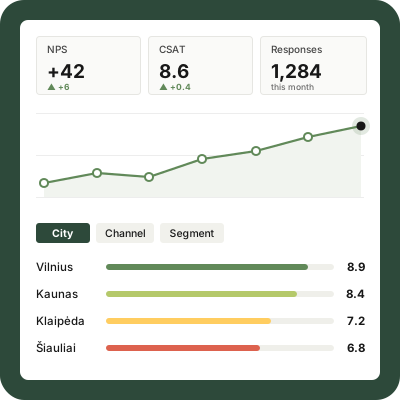
Each response retains its context, which means CSAT can be filtered and compared by:
- business unit;
- service;
- location;
- channel;
- time period;
- customer segment;
- customer journey touchpoint.
The headline score can then be broken down into the segments where the real issues become visible — the differences an overall average can hide.
Analyse open-ended comments
The platform does more than collect comments. It also helps structure and interpret them:
- comment themes are identified;
- sentiment analysis separates positive, neutral and negative feedback;
- recurring problems are highlighted;
- comments are connected with CSAT ratings, making it easier to see what drives low and high scores.
Customisable dashboards
Different roles need different views of the data. Organisations can create separate dashboards for:
- executives – headline KPIs and trends;
- branch managers – their branch results and comparisons with other locations;
- customer service teams – ratings and comments related to their work;
- service owners – performance for their specific service.
Dashboards can be adjusted without custom development, making it easier to create new views and reports as requirements change.
Want to measure CSAT as part of an ongoing customer experience programme rather than through isolated surveys?
Frequently asked questions about CSAT
What is CSAT?
CSAT, or Customer Satisfaction Score, is a customer satisfaction metric that shows what proportion of customers are satisfied with a specific experience, such as a purchase, service interaction, consultation or service. It is measured using a question about a clearly defined experience and expressed as the percentage of respondents who rated that experience positively.
What does CSAT stand for?
CSAT stands for Customer Satisfaction Score. It measures the proportion of customers who report being satisfied with a particular interaction or experience.
How do you calculate CSAT?
CSAT is calculated by dividing the number of positive ratings by the total number of responses and multiplying by 100%. For example, if 82 out of 100 respondents give a rating of 4 or 5 on a 1–5 scale, the CSAT score is 82%.
Is CSAT the average customer rating?
No. An average rating is the arithmetic mean of all scores, for example 4.2 out of 5. CSAT is the percentage of responses classified as positive, for example 82%. The two are related but different metrics. An average can hide the distribution of responses, while CSAT tells you directly what proportion of customers were satisfied.
Which ratings count as positive?
It depends on the scale. On a 1–5 scale, ratings of 4 and 5 are most commonly treated as positive. On a 1–7 scale, it is usually 6 and 7. On a 1–10 scale, the organisation defines a positive range in advance, such as 8–10 or 9–10. The key is to keep the threshold consistent throughout the measurement period.
What is a good CSAT score?
There is no universal threshold. The result depends on the industry, type of service, timing of the survey, scale and customer segment. It is generally more useful to compare your CSAT with previous periods, other branches, channels and customer journey stages. A good CSAT programme is one in which performance is stable or improving and changes can be connected to specific actions.
What is the best CSAT scale?
For most standard CSAT surveys, a 1–5 scale is the most practical. It is easy to understand, quick to complete and clearly separates dissatisfied, neutral and satisfied customers. A 1–7 scale can be useful for more detailed research, while a 1–10 scale may make sense if the organisation already uses 10-point ratings elsewhere. Once a scale is chosen, it should remain consistent so results stay comparable over time.
When should you send a CSAT survey?
As close to the experience as possible, while the customer still remembers it clearly. The most reliable approach is to connect the survey to a system event such as delivery, the end of a consultation or closure of a support case. Manual batch sending often introduces delays and can distort results.
How many questions should a CSAT survey include?
For basic transactional measurement, two questions are often enough:
- one satisfaction rating;
- one open-ended follow-up such as “What was the main reason for your rating?”
A short survey usually generates more responses, while the open-ended question provides the context behind the score.
What is the difference between CSAT and NPS?
CSAT measures satisfaction with a specific experience and is typically collected immediately after the event. NPS measures loyalty and likelihood to recommend — the broader relationship between the customer and the organisation — and is usually measured periodically. The scales also differ: CSAT commonly uses 1–5, while NPS uses 0–10.
Can CSAT and NPS be used together?
Yes. They measure different aspects of the customer experience and complement each other. A common approach is to measure CSAT after specific interactions such as purchases, support contacts or issue resolution, while measuring NPS quarterly or every six months to track the broader relationship.
How often should CSAT be measured?
CSAT is typically event-based rather than calendar-based. It is measured whenever the selected customer journey event occurs. This means the metric can update continuously and performance can be monitored in real time instead of waiting for periodic research waves.
Turn CSAT into an ongoing customer experience signal
Automate surveys after key customer journey events, monitor CSAT in real time and analyse results by business unit, service, location and service channel.
NPS: What It Is, How to Calculate It and How to Interpret the Score
Learn what Net Promoter Score is, how it is calculated from the percentage of Promoters and Detractors, and how to interpret a score ranging from –100 to +100.
Customer Experience Management: From Feedback to Action
Learn how to turn CSAT, NPS and CES measurement into an ongoing process with automated survey distribution, analysis across organisational structures and open-ended feedback analytics.
NPS, CSAT or CES: Which Customer Feedback Metric Should You Use?
There is no single best metric. Learn when CSAT, NPS and CES are most useful and why their value can differ across industries and use cases.