Survey Platform Comparison: Which One Should Your Business Choose?
Today, almost any mature survey platform can help you build a questionnaire. The harder question comes later: how do you turn the feedback you collect into information your organisation can actually use to make decisions?
Apklausa360, Synopticom, Opinico and Survio all let you create surveys, collect responses and analyse results, but their strengths are different. Some focus on a broad self-service survey builder, others on methodologically prepared research programmes, comprehensive market research infrastructure or an always-on customer experience system.
Apklausa360 is built for organisations that want to manage the entire feedback process independently — from questionnaire design, campaigns and entry points to organisational analytics, AI-powered comment analysis and integrations with other systems.
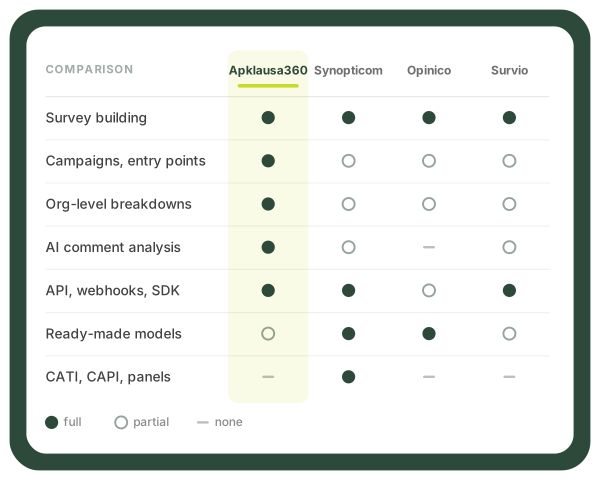
| Criterion | Apklausa360 | Synopticom | Opinico | Survio |
|---|---|---|---|---|
| Primary use case | Self-managed, ongoing customer experience and feedback management | Broad CX and market research infrastructure | Fast launch of methodologically prepared research programmes | General-purpose self-service survey creation |
| Survey creation | Survey Editor, branching, piping, randomisation, multilingual surveys | Advanced builder, screening, piping, randomisation | Custom questionnaires plus 7 ready-made research models | Very broad builder, 100+ templates, AI assistant |
| Self-service process management | End-to-end self-service — Survey Editor, campaigns, entry points, respondent outreach, analytics and dashboards | Broad professional research functionality | Self-service platform with an advisory layer | Very strong self-service model |
| Expert support | Support with measurement design, questionnaires and analysis | Professional CX and market research expertise | KTU-developed research models and SeeNext consulting | Templates, documentation and AI assistance |
| Data collection channels | Links, QR, NFC, email, website, JS SDK, SMS integration | CAWI, CATI, CAPI, SMS, respondent panels, data import | Email, QR, NFC, SMS, website, physical touchpoints | Email campaigns, QR, web embed, URL parameters |
| Open-ended feedback analysis | Automatic topic detection, categories, topic-level sentiment, change signals | Automated text analytics, semi-automated coding | Less detail publicly documented | Topic categorisation, sentiment trends, word clouds |
| Dashboards and organisational analysis | Role-based dashboards, segments, crosstabs and organisational context | Custom reporting and broad research analytics | Real-time metrics, user groups and access controls | Custom dashboards, filters and pivot tables |
| Integrations | API, webhooks, real-time events, JS SDK, SSO, Microsoft Entra ID | CRM, ERP, databases, FTP, web services, RTDI | Integrations agreed individually with internal systems | API, webhooks, Zapier, SSO, audit logs |
| Action after feedback | Signals can be passed into the client’s CRM, helpdesk or another system | Integrated case management | Dedicated case management is not strongly emphasised publicly | Automation through reporting and integrations |
On this page, we compare the four platforms based on the operating model they are best suited to, rather than simply counting feature checkboxes.
On this page:
- In short: how Apklausa360, Synopticom, Opinico and Survio differ
- Where Apklausa360 is strongest
- Why survey platforms are difficult to compare by features alone
- What questions to ask when choosing a survey platform
- Which platform is best suited to which scenario
- How to choose a survey platform
- Frequently asked questions
In short: how do Apklausa360, Synopticom, Opinico and Survio differ?
Apklausa360
A self-service platform for surveys and ongoing customer experience management.
Apklausa360 lets teams manage the full survey process independently: create questionnaires in the Survey Editor, build campaigns, generate entry points, manage respondent outreach, analyse results and create dashboards.
Its strengths become especially clear when feedback is no longer just a one-off survey.
Each response can be linked to business context such as a business unit, location, employee, customer segment, order or another attribute. This means results can be analysed immediately using dimensions that actually matter to the organisation.
Open-ended comments can be analysed automatically by topic and sentiment, different organisational levels can see dashboards relevant to them, and API, webhooks, real-time events and JS SDK integrations allow the feedback process to become part of the wider technology stack.
When needed, the Apklausa360 team can also provide methodological support — what to measure, when to ask, how to design the questionnaire and how to structure the analysis. However, the platform does not depend on consulting services: the client can manage the day-to-day process independently.
Synopticom
Broad customer experience and market research infrastructure.
Synopticom covers Customer Experience Management, Voice of the Customer, Voice of the Employee and market research use cases. The platform includes advanced survey creation, extensive traditional research analytics and a wide range of data collection channels.
It stands out in particular for CATI, CAPI, respondent panels, statistical analysis and integrated case management, where individual customer cases can be assigned to responsible users and conversations and outcomes can be tracked.
It is a strong option for organisations that need customer experience management, complex market research and individual case handling within the same infrastructure.
Opinico
Ready-made research programmes, methodological foundations and a fast start.
The Opinico platform, developed by SeeNext, allows organisations to build their own questionnaires and use research models developed together with KTU researchers — covering areas such as NPS, customer satisfaction, product research and employee experience.
Feedback can be collected by email, QR, NFC, SMS links, website surveys and physical service locations. The technology is complemented by SeeNext’s market research expertise and consulting support.
Opinico is particularly relevant for organisations that want to start quickly with a clearly defined, methodologically prepared research programme.
Survio
A broad self-service survey creation platform.
Survio’s main strength is its extensive survey builder and strong self-service model for a wide range of survey types. The platform offers more than 100 templates, many question types, survey logic, multilingual support and an AI assistant that helps users create, formulate and translate questions.
Distribution options include email campaigns, reminders, QR codes, web embeds and URL parameters. Analytics include filters, pivot tables, dashboards and reports, while enterprise capabilities include API, webhooks, SSO, roles and audit logs.
Survio is a strong option when the primary objective is to give many employees a flexible tool for independently creating and running different types of surveys.
Where is Apklausa360 strongest?
Apklausa360 is not designed simply to replace one survey builder with another.
Its value becomes clearest when an organisation wants to manage an ongoing feedback process independently and use the resulting data in day-to-day operations.
1. The entire process can be managed in-house
Apklausa360 is not a model where every new survey, campaign or integration requires contacting a services team.
The client can independently:
- build surveys in the Survey Editor;
- use branching, piping and other advanced logic;
- create multilingual surveys;
- manage campaigns;
- generate entry points;
- configure different respondent outreach scenarios;
- configure dashboards;
- analyse results.
Expert support from the Apklausa360 team is available when required, but day-to-day use of the product is self-service.
2. From an individual response to business context
A survey response is rarely just a number.
You also need to understand what was happening around that response.
In Apklausa360, feedback can be linked to:
- business unit;
- location;
- employee;
- order;
- customer segment;
- product;
- another attribute available in your systems.
This allows teams to analyse results immediately in a meaningful business context instead of manually joining separate datasets after the survey has ended.
3. From thousands of comments to a handful of important signals
When you receive a few dozen open-ended comments, someone can read them.
When you receive thousands, the main challenge is no longer collecting them — it is understanding what keeps recurring and what is changing.
Apklausa360 AI can:
- identify recurring themes;
- categorise comments;
- use categories defined by your organisation;
- detect sentiment;
- assess sentiment within the context of a specific topic;
- help identify growing problems;
- flag unusual changes;
- identify business units or segments that differ significantly from the overall result.
AI is not used merely to generate questionnaires. Its main value appears after the response has been collected, when large volumes of feedback need to be understood quickly.
4. Different information for different people
Senior management does not need the same view as a branch manager.
Apklausa360 can provide:
- executives — overall performance and trends;
- regional managers — their region;
- branch managers — their location;
- the CX team — organisation-wide analysis and comparisons.
This is supported through custom dashboards, roles and organisational access controls.
5. Feedback as part of the existing technology stack
Apklausa360 does not need to replace your CRM, helpdesk, BI platform or other business systems.
It can operate between them.
Supported components include:
- API;
- webhooks;
- real-time events;
- JS SDK;
- SSO;
- Microsoft Entra ID;
- audit logs.
A feedback process can start in one system, run through Apklausa360 and return a signal or data to another tool already used by the organisation.
When should Apklausa360 be one of the first platforms you evaluate?
If several of the following describe your situation:
- feedback is collected continuously;
- you have many business units, locations, employees or customer segments;
- you want to manage the entire survey process internally;
- different managers need different views of the results;
- you receive large volumes of open-ended comments;
- you want automated topic and sentiment analysis;
- feedback needs to be linked with contextual data from your systems;
- survey results need to trigger processes in other systems;
- you need both technology and access to expert support when designing the measurement model,
Apklausa360 is worth including on your initial shortlist.
Why is it difficult to compare survey platforms by features alone?
When you open the feature lists of several mature platforms, they often look surprisingly similar.
Most offer:
- survey creation;
- survey logic;
- NPS;
- CSAT;
- email distribution;
- QR codes;
- analytics;
- dashboards;
- integrations.
That is why the question “Does it have this feature?” is often no longer enough.
More useful questions are:
- not “Does it have dashboards?” but who needs to see what in those dashboards?
- not “Does it have an API?” but how should feedback move between your systems?
- not “Does it have AI?” but what real problem does the AI solve?
- not “Does it support NPS?” but how will NPS be measured, analysed and used continuously?
- not “Is it self-service?” but how much of the entire process can your team actually manage on its own?
This is where four platforms that look similar at first glance begin to differ significantly.
What questions should you ask when choosing a survey platform?
1. Are you running individual surveys or building an ongoing measurement system?
For one-off surveys, the main priorities are usually:
- create a questionnaire quickly;
- access templates;
- distribute the survey easily;
- get a report.
An ongoing system introduces additional questions:
- at which customer touchpoint should feedback be collected?
- how often?
- what do you already know about the respondent?
- how should results be linked to a branch or employee?
- what should different managers see?
- how should trends be tracked over time?
- where should a signal go when a response requires action?
Apklausa360 can support both scenarios, but its greatest value appears in the second.
2. Does the team need full self-service?
If you plan to manage the survey process internally, do not evaluate only the survey builder.
Ask:
- can the team build questionnaires itself?
- can it change survey logic?
- can it launch campaigns?
- can it create new entry points?
- can it change respondent outreach scenarios?
- can it modify dashboards and analysis?
Apklausa360 is designed for this model.
Clients can independently build surveys, campaigns and entry points, while expert support is used only when genuinely needed.
Survio also has a very strong self-service model and a particularly broad survey builder.
Opinico lets users create their own questionnaires as well as use ready-made research programmes.
Synopticom offers extensive professional survey and research functionality.
3. How will you reach respondents?
If your main channels include:
- email;
- QR;
- NFC;
- website;
- individual links;
- in-product or in-system survey triggers,
it is important to evaluate how easily these entry points can be created and managed.
In Apklausa360, clients can manage them independently.
If you need CATI, CAPI or respondent panels as part of an integrated research infrastructure, Synopticom has a clear advantage.
Apklausa360 does not provide CATI or CAPI research services itself, although interview data collected by the client or a third party can be entered into the platform workspace.
4. Is a simple chart enough, or do you need organisational analytics?
Every serious platform can visualise basic survey results.
The more important questions are:
- do you need to compare business units?
- regions?
- locations?
- employees?
- products?
- customer segments?
- time periods?
- different questions using crosstabs?
- do different managers need different views of the data?
The more often the answer is “yes”, the more the analytics model needs to be designed around the organisation rather than around a single survey.
This is one of the core architectural principles behind Apklausa360.
5. How much open-ended feedback do you receive?
Small volumes of comments can be reviewed manually.
At scale, that approach stops working.
Then you need to:
- detect recurring themes automatically;
- categorise responses;
- analyse sentiment;
- monitor which issues are becoming more common;
- understand where in the organisation those issues are appearing.
Synopticom publicly documents automated text analytics and semi-automated coding.
Survio provides tools for analysing text responses.
Opinico provides less public detail about this layer.
Apklausa360 places significant emphasis on this problem: comments are analysed by themes, categories and sentiment, while the system can help highlight growing or unusual signals.
6. Where should action happen after feedback is received?
It is worth deciding in advance how you want this process to work.
If you want individual negative feedback cases to be managed inside the CX platform itself, Synopticom offers dedicated case management functionality.
If your organisation already uses a CRM, helpdesk or another workflow system, Apklausa360 can send feedback signals into that system via API, webhooks and real-time events.
This avoids creating a second, parallel case management environment — customer cases continue to be managed in the tools where the team already works.
Which platform is best suited to which scenario?
Consider Apklausa360 when...
- you want to manage not only survey creation, but also campaigns, entry points and the entire feedback process internally;
- you are building an ongoing customer or employee feedback system;
- data comes from many customer touchpoints;
- each response needs contextual information such as business unit, location, employee, order or customer;
- results need to be analysed according to your organisational structure;
- different managers need different dashboards;
- you receive large volumes of open-ended feedback;
- automated topic and sentiment analysis is important;
- feedback needs to integrate with your existing IT environment;
- you want both self-service technology and access to expert know-how when needed.
You can see how this process works in practice on the customer experience management page.
Consider Synopticom when...
- customer experience and market research programmes need to operate within one infrastructure;
- you need CATI or CAPI;
- you use respondent panels;
- advanced traditional research analytics are important;
- you need integrated individual customer case management;
- you require a very broad range of data collection methods.
If this matches your scenario, read the detailed Apklausa360 vs Synopticom comparison.
Consider Opinico when...
- you want to start quickly with an existing research model;
- methodological foundations are important;
- you need a specific programme such as NPS, customer satisfaction or another defined study;
- you value SeeNext consulting support;
- QR and NFC feedback collection at physical locations is important;
- your main requirement is a clearly defined research project rather than a broader layer of organisational analytics and integrations.
For more detail, see the Apklausa360 vs Opinico comparison.
Consider Survio when...
- your main requirement is a broad, general-purpose survey builder;
- many employees independently create many different kinds of surveys;
- a large library of ready-made templates is important;
- AI assistance with generating and writing survey questions is useful;
- you want a broad standard survey feature set;
- API, webhooks, SSO and enterprise administration features are important.
If this matches your use case, compare Apklausa360 and Survio in more detail.
How should you choose a survey platform?
Do not choose a platform based on which one has the longest feature list.
Start by defining the process you actually want to manage.
If your priority is broad, self-service creation of many different types of surveys, Survio is particularly worth evaluating.
If you want to launch quickly using methodologically prepared research models with research expert support, Opinico is particularly worth evaluating.
If you need a broad CX and market research solution with CATI, CAPI, respondent panels and integrated case management, Synopticom is particularly worth evaluating.
If you want a fully self-managed, ongoing feedback system where your team creates its own surveys, campaigns and entry points, feedback is then analysed within the organisational context, open-ended comments are automatically turned into themes and sentiment, and data integrates with other business processes, Apklausa360 should be one of the first platforms you evaluate.
There is no single platform that is best for every scenario. But if your goal is an independently managed, ongoing feedback system rather than simply running individual surveys, that is where Apklausa360’s strengths become most relevant.
Show us how you manage customer feedback today
If you currently build surveys in one system, reach respondents through another, analyse results in Excel and still read comments manually, it may be worth looking at the entire process as one system.
Tell us:
- when you collect feedback;
- which channels you use;
- what you already know about the respondent;
- who analyses the results;
- which analytical views you need;
- who needs to act on the signals.
We will show you how your team could manage that process in Apklausa360 — from the Survey Editor and entry points to dashboards, AI analysis and integrations.
Frequently asked questions
Which survey platform should a business choose?
Start with your operating model rather than a feature comparison table. Consider whether you need one-off surveys or an ongoing feedback system, who will build the questionnaires, how respondents will be reached, which analytical breakdowns you need and where action should happen after feedback is received. If a fully self-managed process — from survey creation to organisational analytics and integrations — is important, Apklausa360 is worth evaluating.
Can Apklausa360 be used entirely in self-service mode?
Yes. Apklausa360 includes a Survey Editor for independently creating questionnaires and survey logic, managing campaigns, creating and generating entry points, configuring respondent outreach and analysing results. Expert consulting is an additional option rather than a requirement for using the platform.
What is the difference between a survey platform and a customer experience management platform?
A traditional survey platform primarily solves the problems of questionnaire creation, distribution and response collection. A customer experience management platform adds an ongoing layer around customer touchpoints, respondent context, organisational analytics, different dashboards, text feedback analysis and integrations with other business processes. The distinction is not absolute, because many modern platforms cover both areas. Read more on the customer experience management page.
Where should you start when comparing survey platforms?
Write down your real workflow: what triggers the survey, how the respondent receives it, what information you already know about them, who analyses the response and who needs to react. Once that is clear, it becomes much easier to compare platforms based on the number of steps required to support your actual process rather than theoretical feature lists.
When is it important to choose a platform with CATI or CAPI?
When the research methodology requires telephone or face-to-face interviews as an integrated part of the research infrastructure. In these scenarios, Synopticom has clear advantages. Apklausa360 does not provide CATI or CAPI services, although its workspace can be used to enter interview data collected by the client or a third party.
When is automated open-ended feedback analysis useful?
When the number of comments exceeds what the team can realistically read and categorise manually. At that point, it becomes important to detect recurring themes automatically, analyse sentiment and monitor whether specific problems are becoming more frequent. Apklausa360 automates this process and lets teams analyse the results together with business context such as business unit, location, employee or other organisational data.
Can all survey platforms integrate with other systems?
All four platforms in this comparison offer integration capabilities, but the model differs. Apklausa360 provides API, webhooks, real-time events and JS SDK; Survio provides API and webhooks; Synopticom documents CRM, ERP and real-time data integrations; Opinico offers integrations with internal systems based on individual arrangements. The important question is therefore not only whether “integration is possible”, but how it will work in your specific process.
Customer Experience Management: From Feedback to Action
Learn how to turn NPS, CSAT and CES measurement into an ongoing process with self-managed campaigns and entry points, automated respondent outreach, organisational analytics and open-ended feedback analysis.
NPS: What It Is, How to Calculate It and How to Interpret the Score
Learn what Net Promoter Score is, how it is calculated from the percentages of Promoters and Detractors, and how NPS can be used in ongoing customer experience measurement.
CSAT: What It Is and How to Calculate Customer Satisfaction Score
The CSAT formula, how to choose the right scale, when to measure it and how it differs from NPS and CES.