Apklausa360 vs Synopticom: How Do These Customer Experience Platforms Differ?
Apklausa360 and Synopticom are both serious customer experience platforms. Synopticom is stronger in traditional market research use cases such as CATI, CAPI and respondent panels. Apklausa360 is built around an end-to-end, self-managed feedback process: teams can create surveys in the Survey Editor, build campaigns, generate entry points, reach respondents, analyse results, create dashboards and integrate the process with other business systems.
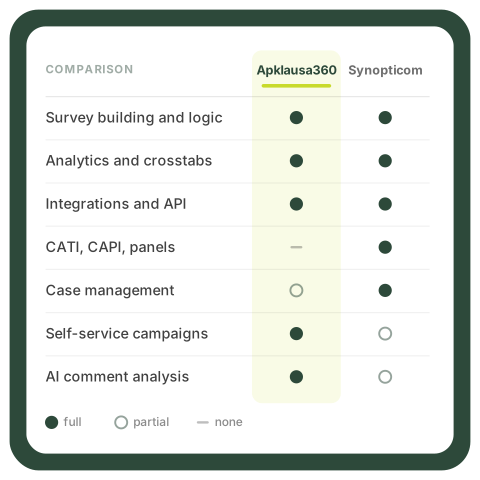
Apklausa360 is designed so organisations can manage the entire ongoing feedback process themselves — from the Survey Editor, campaigns and entry points to organisational analytics, AI-powered comment analysis and data exchange with systems they already use.
Synopticom provides broader traditional market research infrastructure — including CATI, CAPI, respondent panels — as well as integrated case management.
So the more useful comparison is not simply which platform has more features, but how customer feedback needs to work inside your organisation every day.
| Area | Apklausa360 | Synopticom |
|---|---|---|
| Primary operating model | Self-managed ongoing customer experience and feedback system | Customer experience plus broad market research infrastructure |
| Survey creation and logic | Survey Editor, branching, piping, randomisation, multilingual surveys, templates | Branching, skipping, screening, piping, randomisation, multilingual surveys, templates |
| Self-service process management | Surveys, campaigns, entry points, respondent outreach, dashboards and analytics managed independently | Broad professional CX and research functionality |
| Data collection channels | Links, QR, NFC, email, website, JS SDK, SMS integration, manual-entry workspace | CATI, CAPI, respondent panels and a range of data import and collection methods |
| Analytics | Real-time segmentation, crosstabs, organisational breakdowns, custom dashboards | Crosstabs, filtering, indices, correlations, benchmarking and other market research analysis methods |
| Open-ended feedback analysis | Automatic topic detection, organisation-defined categories, topic-level sentiment, change and anomaly signals | Semi-automated coding and automated text analytics |
| Dashboards and access | Role-based dashboards for different organisational levels, SSO, Microsoft Entra ID | Custom reporting and detailed access control |
| Action after feedback | Signals passed to CRM, helpdesk or other systems through API, webhooks and real-time events | Integrated case management covering ownership, communication, outcomes and statistics |
| Integrations | API, webhooks, real-time events, JS SDK, respondent context | CRM, ERP, databases and real-time data integrations |
On this page:
- How are the two platforms similar?
- What is the main difference?
- Survey creation and self-service
- Methodology and expert support
- Data collection channels
- Analytics and dashboards
- Open-ended feedback analysis
- The case management difference
- Integrations with business systems
- When is Apklausa360 the stronger choice?
- When should you choose Synopticom?
- How should you choose?
- Frequently asked questions
Apklausa360 and Synopticom — how are these platforms similar?
The two platforms overlap more than may be obvious at first glance.
Both:
- support not only one-off surveys, but ongoing customer experience programmes;
- support NPS, CSAT and other customer experience metrics;
- allow surveys to be built from scratch or from templates;
- support advanced survey logic, piping and question randomisation;
- support multilingual surveys;
- provide crosstab and segmentation capabilities;
- offer dashboards, reporting and user access controls;
- include functionality for analysing open-ended feedback;
- integrate with other business systems.
That means the decision between Apklausa360 and Synopticom is rarely determined by the question:
“Can the platform do this at all?”
A more useful question is:
“How will our team manage this process, what will we be able to do ourselves, and where should the feedback go once it has been collected?”
The main difference — how feedback becomes an everyday system
Synopticom covers a broad customer experience and market research landscape. Alongside Customer Experience Management and Voice of the Customer, the platform also supports Voice of the Employee, market research use cases, multiple respondent outreach methods and traditional research analytics. For an organisation that wants to combine customer experience programmes, CATI, CAPI, respondent panels and complex market research projects within one infrastructure, that is a meaningful advantage.
Apklausa360 has a different product focus.
Its goal is to let organisations build and manage an ongoing feedback system themselves — one that works alongside everyday business processes.
In practice, that means:
- the CX team creates the questionnaire and configures the logic itself;
- the team builds the campaign and generates the required entry points;
- the survey is triggered after a specific customer action or at a specific touchpoint;
- business context such as business unit, employee or order information travels with the response;
- the result appears immediately in the relevant dashboards;
- comments are analysed automatically;
- when action is required, a signal is sent to the CRM, helpdesk or another operational system.
This is the model of ongoing customer experience management, where the survey is only one component of the process — not a project with a beginning and an end, but a system that runs every day.
Survey creation and self-service
Both platforms support advanced questionnaires
The Apklausa360 Survey Editor allows teams to build questionnaires independently, use templates, configure branching and other advanced logic, apply piping, randomise question order, create multilingual surveys and manage translations.
Synopticom publicly documents a similar core set of capabilities: creating surveys from scratch or from templates, branching, skipping, screening, piping, randomisation, multilingual surveys, multiple question types and respondent filtering.
Advanced questionnaire creation is therefore not the main differentiator. The Apklausa360 difference begins with the fact that self-service does not stop at the Survey Editor.
Apklausa360 self-service goes beyond the Survey Editor
The same team that creates the questionnaire can also:
- build and launch campaigns;
- create and generate entry points;
- manage different respondent outreach scenarios;
- manage multilingual versions;
- analyse results;
- configure dashboards;
- manage users and permissions.
The business impact matters more than the feature list:
When a new business unit, touchpoint or campaign appears, the team does not need to launch a new project or wait for a vendor — the process can be expanded independently.
Day-to-day use follows a full self-service model. Expert support is available when the client needs it, rather than because the product cannot be used without it.
Methodology and expert support
Self-service does not mean the organisation has to make every methodological decision alone.
When needed, the Apklausa360 team can help define what to measure and when, select the appropriate metric — NPS, CSAT, CES or another measure — decide what context should travel with each response, determine which analytical breakdowns will be useful and define what different organisational roles need to see.
This support complements the platform rather than replacing its self-service model. An organisation can start with expert assistance and later manage the day-to-day process itself — particularly valuable when the goal is not one questionnaire, but an entire measurement system.
Data collection channels: where Synopticom has broader research infrastructure
Synopticom offers broader traditional market research infrastructure, including CATI, CAPI, respondent panels and multiple data import and collection methods. If an organisation needs dedicated telephone or fieldwork processes, or access to respondents beyond its own customer base, Synopticom has a clear advantage.
However, when the main feedback stream comes from your own customers and from digital or physical touchpoints, different criteria become more important: how easily the system can be managed every day, and how feedback is linked to business context. This is where Apklausa360 is strongest.
Respondents can be reached through public and unique links, QR codes, NFC, email campaigns, website-embedded surveys, JS SDK, scenarios triggered by other systems and integrated SMS. The client can create and manage these entry points and campaigns independently, so adding a new location or touchpoint does not become a new implementation project.
A key Apklausa360 element — context
The same questionnaire can operate across many touchpoints because the system can receive business context together with the response:
- which location it came from;
- which business unit served the customer;
- which employee was involved in the interaction;
- which order was being evaluated;
- which customer segment the respondent belongs to;
- any other information already available in the business system.
As a result, one NPS or CSAT questionnaire can become an organisation-wide measurement system rather than dozens of separately managed surveys.
Apklausa360 does not provide CATI or CAPI research services. If interview data is collected by phone or face to face, the platform workspace can be used by the client or a third party to enter that data, but this does not replace dedicated CATI or CAPI infrastructure.
Analytics and dashboards
Synopticom has a strong traditional research analytics layer, including crosstabs, filtering, indices, correlations, benchmarking and other market research methods.
In an ongoing customer experience programme, however, the key question is often not how many statistical techniques are available to the analyst, but whether the right person in the organisation sees the right signal when it appears. That is the everyday use case Apklausa360 is designed around.
Results can be monitored in real time and analysed by business unit, employee, location, customer segment and time period. Segments can be compared with one another and analysed using crosstabs. Cross-analysis is not limited to preconfigured dimensions: different survey or data fields can be connected when there is a meaningful analytical relationship between them.
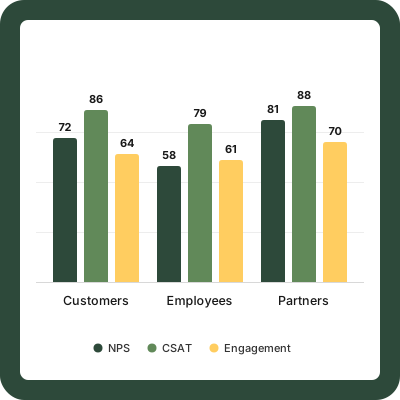
One system — a different view for each role
In a large organisation, one general dashboard is not enough. A manager should not need to know which survey collected a particular response — they need to see the performance of the area they are responsible for and how it is changing.
Apklausa360 allows these views to be built individually and access to be controlled by role and organisational structure.
Senior management
- overall NPS or CSAT;
- trend over time;
- key issues;
- comparison between business units.
Regional manager
- locations within their region;
- changes over time;
- business units that stand out.
Branch manager
- their own branch;
- their customer comments;
- relevant themes.
Customer experience team
- organisation-wide results;
- crosstabs;
- topics;
- sentiment;
- anomalies.
Users can access the platform through SSO, including Microsoft Entra ID, while platform activity is recorded in audit logs.
The practical benefit is simple: less manual report preparation and fewer separate Excel or PDF files being distributed across the organisation. Each person sees the view relevant to them when they need it.
What do you do with thousands of open-ended comments?
When there are only a few comments, technology is barely necessary — someone can simply read them.
When there are thousands, the challenge changes. Then the organisation needs to answer not only:
“What did customers write?”
but also:
- which topics keep recurring?
- which issues are becoming more frequent?
- which topics have the most negative sentiment?
- is the situation changing?
- in which business unit is the issue most pronounced?
- is the overall metric stable while one specific problem is getting worse?
Apklausa360 AI analysis
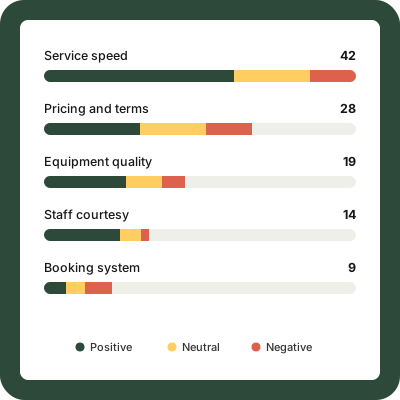
Apklausa360 can:
- automatically identify recurring themes;
- categorise comments;
- use categories predefined by the organisation;
- identify sentiment;
- analyse sentiment within the context of a specific topic;
- help detect emerging issues;
- identify unusual changes in results;
- highlight business units or other segments that differ from the overall pattern.
For example, the overall NPS may remain almost unchanged while the system shows that comments about delivery times have become increasingly negative over the past few months. That kind of signal can be difficult to spot by looking only at the headline metric.
Synopticom also publicly documents automated text analysis and semi-automated coding of open-ended responses. Apklausa360’s differentiation is in how topic, sentiment and change signals are incorporated into ongoing organisational monitoring and dashboards — they are not isolated in a separate analysis layer, but appear alongside the results managers already use.
AI does not make decisions for people. Its role is to surface the signals that deserve attention from a large volume of feedback.
Action after feedback: the case management difference
Synopticom — integrated case management
Synopticom includes dedicated individual customer case management. A negative response can become a separate case, be assigned to a responsible employee, include communication history and resolution outcomes, feed into case statistics and trigger alerts.
If an organisation wants the full closed-loop process to happen inside the customer experience platform itself, this is a genuine Synopticom advantage.
Apklausa360 — action is passed to the system where the team already works
Apklausa360 does not include a built-in case management module. Instead, it follows an integration model: a specific response or triggered condition can be sent through API, webhook or real-time event to a CRM, helpdesk or another workflow system.
If the organisation already has a CRM or helpdesk, there is no need to duplicate case management in another system — Apklausa360 sends the signal to the place where the team already works, using the existing ownership, SLA, queue and escalation logic.
If no such system exists, or if the entire closed-loop process needs to remain inside a single platform, Synopticom’s model has a clear advantage.
Integrations with existing business systems
Synopticom offers a broad enterprise integration layer covering CRM, ERP, databases and real-time data integrations.
Apklausa360’s integration layer includes API, webhooks, real-time events, JS SDK and respondent context. More important than the list itself is how these capabilities form an operational process:
The customer completes an action
An order, consultation or another event takes place in a CRM, e-commerce platform, self-service environment or another system.
The system triggers a survey
Existing context about the customer, business unit, employee or order is passed along at the same time.
The respondent submits feedback
Through the entry point that best fits the specific touchpoint.
The response is analysed
Immediately within the relevant organisational dimension — by business unit, location, segment or time period.
Dashboards update
In real time, with each role seeing its own view.
The signal is passed onward
If the response meets a defined condition, a webhook or real-time event sends it into another system.
A large part of this workflow — surveys, campaigns, entry points, analytics and dashboards — can be managed by the client directly, while API, webhooks and real-time events provide a standard foundation for connecting the process with other systems. In this model, Apklausa360 becomes the feedback layer between different organisational systems, rather than another isolated data repository.
When is Apklausa360 the stronger choice?
Apklausa360 is particularly strong when the feedback process needs to run continuously and scale with the organisation. You can start with one NPS or CSAT programme and later add new business units, campaigns, touchpoints, dashboards and integrations within the same self-service environment.
You do not need a sophisticated customer experience programme from day one. Over time, the organisation may add more business units and languages, more campaigns and touchpoints, more users, custom dashboards, AI-powered comment analysis and integrations — as the process becomes more complex, the same platform can expand with the new requirements.
Apklausa360 is worth including on your shortlist if:
- you want to manage the entire survey process internally — from the Survey Editor to campaigns and entry points;
- you are building an ongoing customer or employee feedback programme;
- feedback comes from many different touchpoints;
- results need to be linked automatically to business unit, location, employee, order or other business context;
- different managers need different dashboards;
- you receive large volumes of open-ended comments and want to identify topics, sentiment and emerging issues automatically;
- feedback needs to integrate with an existing CRM, helpdesk or other systems;
- you want self-service technology with the option to involve expert support when needed.
If your challenge is no longer “How do we build a survey?” but “How do we make customer feedback work continuously across the organisation?”, this is where Apklausa360’s strengths become most relevant.
When should you choose Synopticom?
Synopticom’s strengths are clear:
- dedicated CATI workflows;
- online and offline CAPI;
- respondent panels;
- complex traditional market research and broad research analytics;
- integrated individual customer case management.
If these are your primary purchasing criteria, Synopticom may be the more suitable option.
Apklausa360 or Synopticom — how should you choose?
Both platforms can support serious customer experience programmes, so the decision should be based on your operating model.
Synopticom — when you need broad market research infrastructure, CATI, CAPI, respondent panels and integrated case management in one system.
Apklausa360 — when you are choosing for the longer term and expect one NPS or CSAT programme to evolve into continuous feedback across multiple touchpoints, with Survey Editor, campaigns, entry points, organisational context, custom dashboards, AI-powered comment analysis and real-time integrations managed in one self-service environment.
The most important question is not “Which platform has more features?” A better question is: where do you want to manage the feedback process, who will use it, and what needs to happen after a response is received?
For a self-managed, ongoing feedback model, Apklausa360 should be one of the first options you evaluate.
If you are also considering other solutions, see the broader survey platform comparison.
Frequently asked questions
How is Apklausa360 different from Synopticom?
Both platforms provide broad customer experience functionality, advanced surveys, crosstab analysis, dashboards and integrations. Synopticom’s main strength is its broader traditional market research infrastructure — CATI, CAPI, respondent panels and integrated case management. Apklausa360’s main strength is a fully self-managed ongoing feedback process: Survey Editor, campaigns, entry points, organisational analytics, AI-powered comment analysis and integration with existing business systems.
Can Apklausa360 be used entirely in self-service mode?
Yes. Clients can create surveys in the Survey Editor, manage logic and translations, build campaigns, create and generate entry points, configure respondent outreach scenarios, analyse results and work with dashboards independently. Expert consulting is an additional option rather than a requirement for using the platform.
Is Apklausa360 an alternative to Synopticom?
For many ongoing customer experience management scenarios, yes. If an organisation specifically requires CATI, CAPI, respondent panels or integrated individual customer case management, Synopticom covers those areas more broadly.
Which platform is better suited to NPS and customer experience measurement?
Both support NPS and are suitable for ongoing customer experience measurement. Apklausa360 is particularly strong when NPS or CSAT need to be collected automatically across many touchpoints, linked with business units, employees or other organisational attributes, and presented to different people through dashboards tailored to their responsibilities.
Does Apklausa360 support advanced survey logic?
Yes. The Survey Editor supports branching, piping, question randomisation, multilingual surveys and translation management — all in self-service mode without requiring a separate vendor request.
Do both platforms integrate with CRM and other business systems?
Yes. Synopticom offers a broad enterprise integration layer covering CRM, ERP, databases and real-time data integration. Apklausa360 provides API, webhooks, real-time events, JS SDK and respondent-context transfer, allowing surveys to be triggered by another system and responses or signals to flow back into it.
When might Synopticom be the better choice?
When you need CATI or CAPI research infrastructure, respondent panels, broad traditional market research analytics or integrated individual customer case management within the same platform.
See how the entire feedback process can work in one platform
Show us how you currently build surveys, launch campaigns, reach respondents and analyse results. We will show you how your team could manage that process in Apklausa360 — from the Survey Editor and entry points to dashboards, AI analysis and integrations.
Customer Experience Management: From Feedback to Action
Learn how to turn NPS, CSAT and CES measurement into an ongoing process with self-managed campaigns and entry points, organisational analytics, dashboards and open-ended feedback analysis.
NPS: What It Is, How to Calculate It and How to Interpret the Score
Learn what Net Promoter Score is, how it is calculated and how NPS can be used in ongoing customer experience measurement.
CSAT: What It Is and How to Calculate Customer Satisfaction Score
Learn the CSAT formula, how to choose the right scale, when to measure it and how it differs from NPS and CES.
Platform Comparison: Apklausa360, Synopticom, Opinico and Survio
Compare four survey and customer experience platforms based on their core use cases.