Apklausa360 vs Opinico: How Do These Survey Platforms Differ?
If you need to launch a specific NPS or customer satisfaction survey quickly, Opinico offers a clear proposition with ready-made research models developed together with KTU researchers. Apklausa360 is designed for organisations that want to do more than run an individual study. It supports the entire feedback process in self-service mode — from questionnaires, campaigns and entry points to organisational analytics, AI-powered comment analysis and integrations with other systems. The difference becomes most visible not in the first week, but later, when measurement becomes continuous and needs to scale with the business.
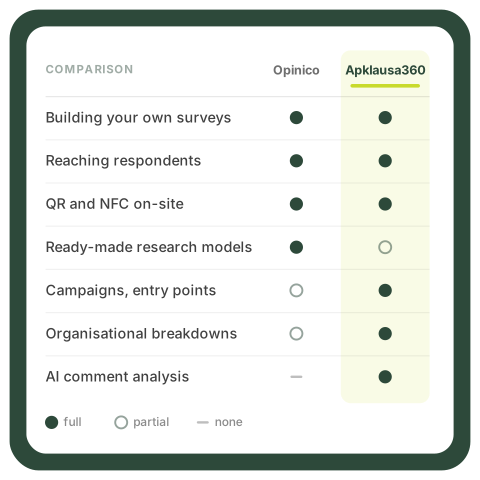
| Area | Opinico | Apklausa360 |
|---|---|---|
| Ready-made research programmes | 7 questionnaires developed with KTU researchers, designed for a fast start | Templates plus fully custom questionnaires created in the Survey Editor |
| Building your own questionnaires | Yes, in self-service mode | Survey Editor, branching, piping, randomisation, multilingual surveys |
| Self-service and scalability | Self-service research platform with an advisory layer | Surveys, campaigns and entry points can be created and expanded independently |
| Respondent outreach | Links, email, website, social media, SMS links, QR, NFC | Public and unique links, campaigns, email, QR, NFC, website, JS SDK |
| Analytics | Data analysis tools, visualisation, real-time metrics | Segmentation, analysis by business unit, employee and location, crosstabs |
| Open-ended comments | Not described in detail in the public product information | AI-powered topic detection, categorisation and sentiment analysis |
| Result distribution | User groups with configurable access to information and studies | Custom dashboards and access rights aligned with organisational structure |
| Integrations | Available through individually agreed additional services | API, webhooks, real-time events and JS SDK as part of the product |
| Expert support | SeeNext market research expertise and methodological consulting | Consulting when needed; day-to-day use remains self-service |
On this page:
- What can both platforms do?
- Ready-made research and a fast start
- Survey methodology
- Self-service: what can your team manage independently?
- Feedback across physical and digital touchpoints
- What changes when survey volumes grow?
- Open-ended comments, topics and sentiment
- Integrations and automation
- When should you consider Opinico?
- When is Apklausa360 the stronger choice?
- How should you choose?
- Frequently asked questions
Apklausa360 and Opinico — what can both platforms do?
When choosing a survey platform, it is easy to start with the question of whether it can create questionnaires and collect responses. That is not a meaningful differentiator here — both platforms can do that.
Opinico is an online survey platform developed by SeeNext together with KTU researchers and positioned around scientific and methodological principles. Its public materials emphasise data collection, analysis, visualisation, real-time metric tracking and use in both digital and physical environments. In practice, both platforms can:
- create custom questionnaires;
- use ready-made research models;
- measure NPS and customer satisfaction;
- collect responses through links, email, QR and NFC;
- analyse and visualise results;
- support multiple users;
- integrate with internal systems.
The more important question is therefore different: how much of the end-to-end feedback process can your team manage independently — and how far can the platform scale with you once measurement becomes continuous?
Ready-made research and a fast start — Opinico’s strength
An organisation does not always need to start from a blank questionnaire. This is one of Opinico’s clearest strengths: SeeNext, together with KTU researchers, has developed seven ready-to-use questionnaires, including overall customer satisfaction, Net Promoter Score, product experience and employee satisfaction research. For organisations that want to start quickly with a clearly defined, methodologically structured study, this is a practical and rational approach.
But a ready-made research model solves only the first question: how do we start measuring? Once feedback becomes an ongoing process, other questions appear:
- how will the team manage campaigns and entry points on its own;
- how will each response retain business context;
- how will different managers access the views relevant to them;
- what happens when thousands of open-ended comments start accumulating?
This is where the main differentiation of Apklausa360 begins.
Survey methodology — both platforms offer more than technology
Survey quality depends not only on the software, but also on how the questions are designed. Both platforms therefore include an expert-support layer. SeeNext is a market research company that has been conducting research since 2016 and offers consulting on questionnaires and methodology. The Apklausa360 team can also help determine what to measure, select the right metrics and design meaningful analytical breakdowns.
The difference is not whether consulting exists, but the role it plays. With Apklausa360, expert support is an additional benefit rather than a prerequisite for using the platform. The team gets involved when the client needs it, not because the platform cannot be operated without consulting services. As measurement evolves into an ongoing system, this support can also extend to architecture: which customer journey stages should be measured, what context should be passed from business systems, and what dashboards different people across the organisation will need.
Self-service: what can your team manage independently?
Apklausa360 is not a model where every new survey, campaign or entry point requires a request to a service team. Clients can independently:
- create and edit surveys in the Survey Editor;
- use branching, piping and other advanced survey logic;
- randomise question order;
- create multilingual surveys and manage translations;
- build campaigns and configure their logic;
- create and generate entry points;
- set up different respondent outreach scenarios;
- control survey launches;
- analyse results, including crosstabs;
- create and adjust dashboards;
- manage users and access rights.
Expert support is available when needed, but day-to-day product use is self-service.
What does self-service mean for the business?
This is not merely a technical detail. It directly affects how quickly the organisation can respond:
- when a new location opens, there is no need to commission a separate project — a new entry point can be created immediately;
- a new customer journey touchpoint can be added to the measurement programme by the internal team;
- campaigns can be launched when the business needs them, not when an external provider becomes available;
- if a process changes, the questionnaire or survey logic can be updated without additional development work;
- new analytical views or reports do not require waiting for an external resource.
As the measurement programme grows, every new business unit, campaign or touchpoint does not need to become a separate technology project. The team can expand and adjust the system itself, retaining both control and operational speed.
Feedback across physical and digital touchpoints
Both platforms can collect feedback in physical environments such as stores, service centres, restaurants and other customer-facing locations. Opinico publicly lists links, email signatures, websites, social media, newsletters, SMS links, QR codes and NFC. Apklausa360 supports public and unique links, campaigns, QR, NFC, website integrations and JS SDK. The channel itself is therefore not the main differentiator.
The difference becomes more apparent in the context attached to each response. An Apklausa360 entry point can carry structured information, so when the same questionnaire is opened, the system can already know or receive:
- business unit;
- employee;
- location;
- order;
- customer segment;
- product;
- channel;
- another attribute known in the business system.
The business impact is practical. Business units can be compared immediately, results can be analysed by employee, underperforming locations can be identified quickly, and feedback from specific customer segments can be reviewed without additional data preparation. There is no need to manually join datasets after the survey — the feedback arrives already enriched with the context required for analysis.
How much of your feedback process do you control internally?
Let’s discuss how you currently build surveys, reach respondents and share results — and how much of that process your team could manage without relying on external resources.
As survey volumes grow, understanding matters more than collection
Imagine an organisation with fifty locations continuously collecting NPS and CSAT feedback from each one. There is one headline metric, but that number does not tell you which location is changing, which topics are becoming more common in comments, or what a specific customer segment is increasingly unhappy about. The audience for the data also changes. The same dataset needs to answer different questions for different people.
For senior management
The headline metric, its trend and the largest differences between regions — a level where the organisation sees patterns rather than isolated cases.
For a regional manager
A comparison of locations within their region, changes over time and branches that stand out from the overall result.
For a branch manager
Their own location’s performance, specific customer comments and the KPIs they are responsible for.
For the central CX team
Organisation-wide comparisons, topic distribution and evidence of which interventions actually produced results.
Apklausa360 results update in real time. Data can be filtered and segmented by time period, business unit, employee, location and other attributes, compared across segments and analysed using crosstabs. Custom dashboards can be built for senior management, the central CX team, business unit managers or regional teams, while access is controlled according to the organisational structure.
The key benefit is not the feature itself, but what it removes from the process: the same system can serve the entire organisation. There is no need to prepare separate Excel files, manually distribute reports to every manager or run a separate study for each audience. The team can adjust dashboards independently, so new analytical views do not require additional development. At that point, the discussion is no longer only about surveys — it becomes a question of ongoing customer experience management.
Open-ended comments — from raw text to topics and sentiment
When there are 100 comments, someone can read them. When there are 10,000, manual review no longer scales. A quantitative trend line shows that the result is changing, but not why. Reading only a subset of comments introduces another risk: the team may notice what is most memorable rather than what is actually most important.
Apklausa360 uses AI not primarily to generate questionnaires, but after responses are collected, when large volumes of feedback need to be understood quickly. The platform can:
- automatically identify recurring themes;
- categorise comments;
- use categories predefined by the organisation;
- detect sentiment;
- analyse sentiment within the context of a specific topic;
- help identify growing issues before they materially affect the headline metric;
- detect unusual changes in results;
- highlight business units or segments that deviate from the overall pattern.
In practice, this means a declining Customer Satisfaction Score does not have to remain unexplained. The platform helps not only calculate how many customers are satisfied, but also understand what is changing in their experience.
Opinico’s public product information does not describe automated topic and sentiment analysis in detail.
Integrations and automation
Both platforms can integrate with internal systems, but their delivery models differ — and that has practical consequences.
SeeNext states that Opinico integrations with internal systems are available through individually agreed additional services. If integration is a one-off, clearly defined project, that model may be entirely sufficient.
Apklausa360 provides a productised integration layer — API, webhooks, real-time events and JS SDK. This allows new feedback workflows to be built on a standard technical foundation rather than designing each integration from scratch. The process can continuously respond to events in other systems, receive business context in real time and send signals back into the organisation’s existing tools. For enterprise requirements, the platform also supports SSO with Microsoft Entra ID, audit logs, user roles and access management aligned with organisational structure.
What does this look like in day-to-day operations?
An order is completed
The customer completes a purchase or service interaction in another system — a CRM, e-commerce platform or helpdesk.
The survey is triggered automatically
The survey launches without manual list uploads or a separate distribution cycle.
Respondent context is passed along
Order details, business unit, employee or customer segment travel with the survey, so the response already has business context.
A response is received
The result enters the same system as the rest of the feedback, already enriched with the attributes required for analysis.
Dashboards update
Responsible users see the change in real time within their own view — without waiting for a separate report.
Critical signals move downstream
A negative rating or specific topic can be passed by webhook to the responsible team in the system they already use every day.
When should you consider Opinico?
Opinico is worth serious consideration when the priority is to launch a specific research programme quickly and start from a methodological foundation:
- the main requirement is a specific ready-made study;
- speed of launch is important;
- methodology developed together with KTU researchers is valuable;
- the SeeNext market research consulting layer matters;
- QR, NFC and other standard feedback channels cover the use case.
When is Apklausa360 the stronger choice?
Apklausa360 becomes especially relevant when the feedback process needs to grow together with the organisation. You can start with a single NPS or CSAT survey — the templates and Survey Editor are fully suitable for that. The difference appears later: as new business units, touchpoints, campaigns and analytical requirements emerge, the same platform can scale with them rather than treating each new scenario as a separate project.
It is worth evaluating when:
- you want to manage the day-to-day process — surveys, campaigns, entry points and analysis — independently;
- feedback is collected continuously across many touchpoints;
- responses need to be enriched with business context at the point of collection;
- segmented and crosstab analysis by business unit, employee and location is important;
- different managers need different dashboards and access rights based on organisational structure;
- you receive large volumes of open-ended comments that require AI-powered topic and sentiment analysis;
- feedback needs to exchange data with CRM, helpdesk or BI systems;
- SSO, audit logs and enterprise-grade access management are required;
- you want self-service technology with the option to involve expert support when needed.
If the organisation needs not only to run a study, but to build a system that the internal team can expand, manage and use every day, Apklausa360 should be one of the first options you evaluate. For a broader overview, see the Apklausa360 homepage.
Apklausa360 or Opinico — how should you choose?
Opinico is a strong option when the main goal is to launch a specific, methodologically prepared study quickly.
Apklausa360 can start from the same simple NPS or CSAT use case, but its advantage becomes more relevant as requirements expand: more touchpoints, campaigns, organisational views, users, comments and integrations can all be managed within the same self-service system.
The comparison should therefore not be based primarily on organisation size. A small company can have a complex customer experience process, while a large organisation may need only one clearly defined NPS study.
If you are choosing a platform not only for your next survey, but also for how the feedback process should work in one or two years, it is worth evaluating how easily the chosen system can scale with your organisation. If you are comparing a broader set of options, the survey platform comparison guide may also be useful.
See how your feedback process could work in Apklausa360
Show us how you currently create surveys, launch campaigns, reach respondents and analyse results. We will show you how your team could manage that process in Apklausa360 — from the Survey Editor and entry points to dashboards, AI analysis and integrations.
Frequently asked questions
How is Apklausa360 different from Opinico?
Both platforms allow organisations to create surveys, collect responses online and at physical locations, and analyse results. Opinico publicly emphasises fast deployment and questionnaires developed together with KTU researchers. Apklausa360 focuses on the complete ongoing feedback process managed directly by the client: Survey Editor, campaigns and entry points, respondent context, crosstab analytics, custom dashboards, AI-powered comment analysis and productised integrations.
Can Apklausa360 be used without consultants?
Yes. Apklausa360 includes a Survey Editor for independently creating questionnaires and survey logic, managing campaigns, creating and generating entry points, configuring respondent outreach, analysing results and adjusting dashboards. Expert consulting is an additional option rather than a requirement for using the platform.
Is Apklausa360 an alternative to Opinico?
Yes. The two platforms address similar use cases, so comparing them is reasonable. Apklausa360 can start with the same type of simple survey, but is designed to support the process as it expands — with more touchpoints, campaigns, organisational breakdowns and integrations managed within the same system.
Are both platforms suitable for NPS surveys?
Yes. Opinico offers a ready-made NPS research model that can be launched quickly. Apklausa360 supports NPS, CSAT, CES and custom metrics, with its main use case focused on ongoing measurement, segmented analytics and AI-powered analysis of open-ended comments.
Can Opinico and Apklausa360 both be used in physical service locations?
Yes. Both support QR codes and NFC. The difference is not the channel itself, but the context attached to the response. In Apklausa360, structured information can be assigned to each entry point, so the same questionnaire can already know which business unit, location or employee the response relates to, without requiring manual data joins later.
Can both platforms integrate with company systems?
Yes, but the delivery model differs. SeeNext states that Opinico integrations with internal systems are available through individually agreed additional services. Apklausa360 provides a productised integration layer including API, webhooks, real-time events and JS SDK. This means new feedback workflows can be built on top of a standard technology layer instead of designing each integration from scratch.
NPS: What It Is, How to Calculate It and How to Interpret the Score
Learn what Net Promoter Score is, how it is calculated and how NPS data can be turned into action.
CSAT: What It Is and How to Calculate Customer Satisfaction Score
Learn the CSAT formula, how to choose the right response scale and how CSAT differs from NPS and CES.
Customer Experience Management
Learn how measurement, analytics and action can be brought together into one process that turns feedback into decisions.
Platform Comparison: Apklausa360, Synopticom, Opinico and Survio
See how the four survey platforms differ, which criteria matter when choosing between them and which use cases each platform is best suited to.